
Vidè
Vermentino Colli di Luni DOC · 100% vermentino
The white that bears my grandmother Videa’s name, the same as our agriturismo.

Home cooking and family wines, in a stone village from 1749 between Tuscany and Liguria.
Our story
My name is Francesca. Cà Vidè is my family’s home, in Caprognano: a handful of stone houses, a little church from 1749 and, all around, our vines and our vegetable garden.
The name is a tribute — “Vidè,” after my grandmother Videa. A short walk away is Tenuta Marchini, which carries the surname of my mother and of my grandfather Gino, the man I owe my love for this land to.
I grew up among the vine rows, I studied to learn how to make wine, and I came back here, where it all began. Since then we’ve done the same two things, with the same hands: we grow — wine and vegetables — and we cook. My sister Sara is in the kitchen; I’m in the dining room, welcoming you. In 2016 we opened the doors of the old barn, and from that day you’ve been part of it too.


The restaurant
The restaurant lives inside an old hay barn, restored and set over two floors. Just a few tables — around twenty seats — laid with our grandmothers’ tableware.
Sara’s cooking is simple and seasonal, Tuscan-Ligurian, made with what grows in our garden and with ingredients we choose one by one. The menu changes often, because it follows the garden and Sara’s ideas.
There’s always a dish for vegetarians. For anyone who’s celiac: we’ll put together something without gluten, but we cook in a single kitchen and can’t guarantee there’s no cross-contamination — we’d rather tell you honestly.


Press
From our 4 Ristoranti episode to the newspapers and guides that came to see us — and what they wrote.


4 Ristoranti
In 2020 Cà Vidè was one of the contenders on Alessandro Borghese’s 4 Ristoranti, the episode devoted to the villages of the Lunigiana.
We took part exactly as we are, no filters: me in the dining room, Sara at the stove, and our everyday cooking. The bonus dish of that challenge was sgabei — strips of fried leavened dough, a Lunigiana classic — and ours, made with chestnut flour, won the chef’s bonus point. We didn’t win the episode, but we came home with something that matters more: the proof that cooking simply, with the products of our own land, is the right road.
The memory of the grandparents, the balance, the easy charm of Vidè: 4,000 bottles, native yeasts only and 24 hours of fermentation on the skins.
Elisa Alciati
Read — Tenuta Marchini, Passione GourmetFrancesca is the soul — in the truest sense of the word — of Tenuta Marchini.
Lorenzo Colombo
Read — Tenuta Marchini: Francesca’s wines, LaviniumHere the watchwords are honesty and warmth. The old hay barn has been restored and turned into a welcoming restaurant.
Fosca Tortorelli
Read — Tenuta Marchini: the energy of the Colli di Luni, Di Testa e Di GolaRead — Sgabei and Lunigiana delicacies on “4 Ristoranti”, QuiNews LunigianaA village of 25 souls, where the simple, tradition-rooted atmosphere leaves a fine impression on the guests.
Read — Agriturismo Cà Vidè, Wine Lovers ItalyKeepers of the taste of what is genuinely good — always with a smile.
Read — Agriturismo Ca’ Vidè — Caprognano (MS), Il Blog di PetardoThe last few kilometres of the picturesque road up to Ca’ Vidè are narrow and a little rough, but they are well worth it. In short: an excellent experience, and one we recommend.
Wines & tastings
Small numbers, made by hand, each one carrying a family name.

Vermentino Colli di Luni DOC · 100% vermentino
The white that bears my grandmother Videa’s name, the same as our agriturismo.
Vermentino Colli di Luni DOC · 100% vermentino
Ribella is a spot here in Caprognano, where the vineyards once were. The label was drawn by our son Giorgio at three years old, when his little brother Francesco was born: two children inside their mother’s belly. It stayed just like that — and it looks like us.
Red · Vino d’Italia · Merlot and Canaiolo
Dedicated to my great-grandfather Giovanni.
Red · Toscana IGT · Merlot and Canaiolo
The name comes from Mario and Antonella, my parents.


The night harvest
We pick our vermentino at night. Not as a fashion: we do everything by hand and we have no cold rooms, so we wait for the dark, and for the temperature to drop with it. The grapes reach the cellar cool, and with them stay the aromas we’re after in the wine.
It’s a slower harvest, made of lamps between the rows and of silence. But it’s our way of respecting the grape — and when you taste the Vidè, a little of those nights is there in the glass.

We grow naturally, with little and with patience, so the wine tastes of where it’s born. The vermentino we harvest at night.
The cellar
Our wines rest in a cellar carved into the rock, beneath the village: stone and brick vaults, terracotta floors, and a temperature that stays cool on its own, all year round.
Here the vermentino and the reds ferment and age slowly, in steel tanks, tended day by day. It’s slow, patient work — the same we put into the garden and the kitchen.


Our products
Four things born right around us that end up on your plate.

01
What you eat is mostly born right here. The garden is where the menu starts: it grows, Sara decides. The vegetables, the aromatic herbs, the jams you find on our desserts — it’s all ours, picked and prepared a few steps from the table.
That’s what a real agriturismo means to us: a short circle, from field to plate, with no shortcuts.

02
In autumn, when the woods are generous and the conditions are right, we go looking for porcini in the areas around us. We pick them ourselves and take them straight to the kitchen.
It’s not something we can promise on a calendar — it depends on the rain, the season, the woods. But when they’re here, you’ll find them on your plate: one of autumn’s finest gifts in this corner of the world.


03
The jams you’ll find on our desserts and beside the cheeses are all our own. We make them with fruit from the garden and the village: figs, plums, pears, kumquat, vermentino grapes — and then the ones that catch you off guard, cucumber and green tomato, often the favourites of those who try them.
Nothing industrial: just fruit, season and patience, sealed in jars the old way.

04
The chestnut trees grow all around us, and in autumn we gather the chestnuts, dry them and grind them into our own flour. It’s the one we use in the kitchen — the same flour as our sgabei, the ones that won the chef’s bonus point on 4 Ristoranti.
It’s slow work, the kind few people still do. But it’s also the oldest flavour of this land, and we like to keep it alive.
Events & celebrations
Cà Vidè is an intimate place, and for certain occasions that’s exactly its charm. Christenings, communions, birthdays: with the numbers of a family party — thirty, thirty-five people — we’re comfortable indoors too, whatever the weather.
In summer we’ve also hosted larger weddings, around sixty guests, in our wide outdoor space. For those we talk it through together: the village is at its best in fine weather, and with the couple we always agree in advance how to handle it. Those who wish can marry in the village’s little chapel — some already have.
Tell us the day you have in mind, and we’ll see how to make it ours.

Gallery
Tap a photo to enlarge it
Frequently asked questions
If you can’t find what you’re looking for, just call us: we answer personally.
Yes, it’s always best — we’re a small place. Call us on +39 0187 671811 or +39 333 5985257, or message us on WhatsApp at +39 333 5985257.
We’re in Caprognano, at Via Caprognano 18, Fosdinovo (MS). We sit between Castelnuovo Magra and Fosdinovo, on the border between Tuscany and Liguria. There are two roads up to us but one is closed after a landslide, so we’ll give you the directions you need when you book.
To reach Cà Vidè set your sat nav to Caprignano; once you see the sign, carry on for about 1.5 km to Caprognano.
Here’s a map to give you an idea of the way up.
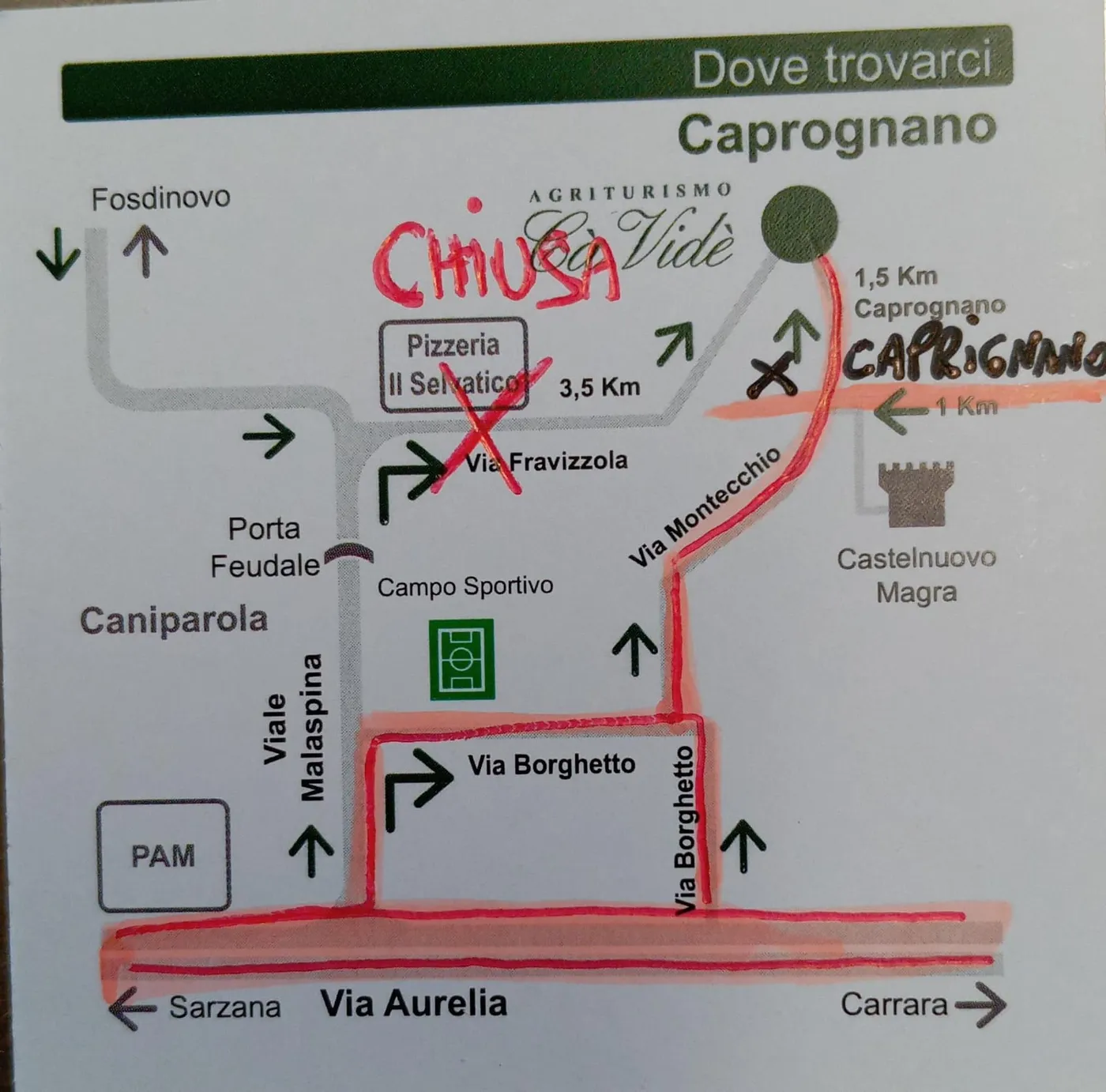
We’re about 7-10 minutes from the Aurelia road, and it’s an easy drive. We have all the parking you need.
Home cooking, Tuscan-Ligurian and seasonal, made mostly with what grows in our garden. The menu changes with the seasons.
There are always dishes for vegetarians. For celiacs we’ll put together something without gluten, but we cook in a single kitchen and can’t guarantee there’s no cross-contamination — we’d rather tell you honestly.
At our table you drink only our own wine, from Tenuta Marchini. By reservation we arrange tastings: we open one or more wines, paired with our focaccia and a board of cured meats.
Yes. Christenings, communions and birthdays of thirty to thirty-five people are comfortable indoors too, whatever the weather. In summer we’ve hosted weddings of up to about sixty guests in our wide outdoor space; those who wish can marry in the village chapel. Tell us what you have in mind.
No — we’re an agriturismo restaurant only, with no accommodation.
Yes. In 2020 we took part in Alessandro Borghese’s 4 Ristoranti, in the Lunigiana episode, and our sgabei won the chef’s bonus point.
Where we are & contact
We’re an agriturismo and restaurant in Fosdinovo, in the Lunigiana: in Caprognano, a cluster of houses above the village, on the border between Tuscany and Liguria. There’s plenty to lose yourself in nearby: the Malaspina Castle of Fosdinovo, the Apuan Alps, and the sea of the Cinque Terre just a step away.
Reservations are made only by phone or WhatsApp: there is no online booking.